Updates
The Truth About EdAccelerator: Lessons From 1,000 Students
Oct 13, 2025
/
9 min read
/
Charlie Franklyn, Founder

Over the past few years, I’ve tutored more than 1,000 students in English.
Many of them started out disliking English — some even said they hated it. They couldn’t bear to start writing or read a book on their own.
Others were high-achieving students already working ahead of the school curriculum, looking to push themselves 6–12 months further. But even they often didn’t enjoy English - or felt unsure about how to actually keep improving.
But after speaking with hundreds of parents, I’ve heard the same thing again and again:
“We’ve tried other English tutoring, but it didn’t work. My child didn’t enjoy it, they resisted it, it led to friction and tears at home, or it just didn’t make a difference. I looked at their writing after a few months, and it still looked the same.”
This is the problem that so many parents face today.
But after working with thousands of students, it became clear to me that there are three key drivers of progress in English, one for each core domain of the subject.
English can be broken down into three components:
Writing — the ability to express ideas clearly and creatively.
Reading — the ability to understand, interpret, and analyse texts.
Language — the foundation of vocabulary, grammar, and sentence structure that supports both reading and writing.
And for each of these, there’s one simple strategy that almost guarantees improvement — no matter where a student starts.
The simplest place to start is with Language.
Many students join EdAccelerator struggling with spelling. They make frequent mistakes that hold back their writing.
Later on, parents start to worry that their child’s vocabulary isn’t growing fast enough. They struggle to use precise and powerful words in their writing and speaking.
This is the easiest problem to solve because it takes only one thing — consistency.
Even just one minute a day spent learning new words or practising to spell tricky words adds up overtime.
Even just one minute a day spent learning new words or practising to spell tricky words adds up over time.
Within the EdAccelerator program, we encourage students to spend a minimum of 1 minute per day on Spelling and 1 minute per day on Vocabulary.
The outcome? The average student learns to spell 8 new words each week and understand the meaning of 9.
That might not sound like much, but over time that’s around 70 words per month, or more than 850 words per year.
When you consider that at school the average student learns only 100–200 words explicitly per year, that’s 4 to 8 times more.
And that’s with just one minute a day. We have students who take it further — learning 30, 40, or even 50 new words a week.
You might be thinking, “But my child won’t even want to do a minute!”
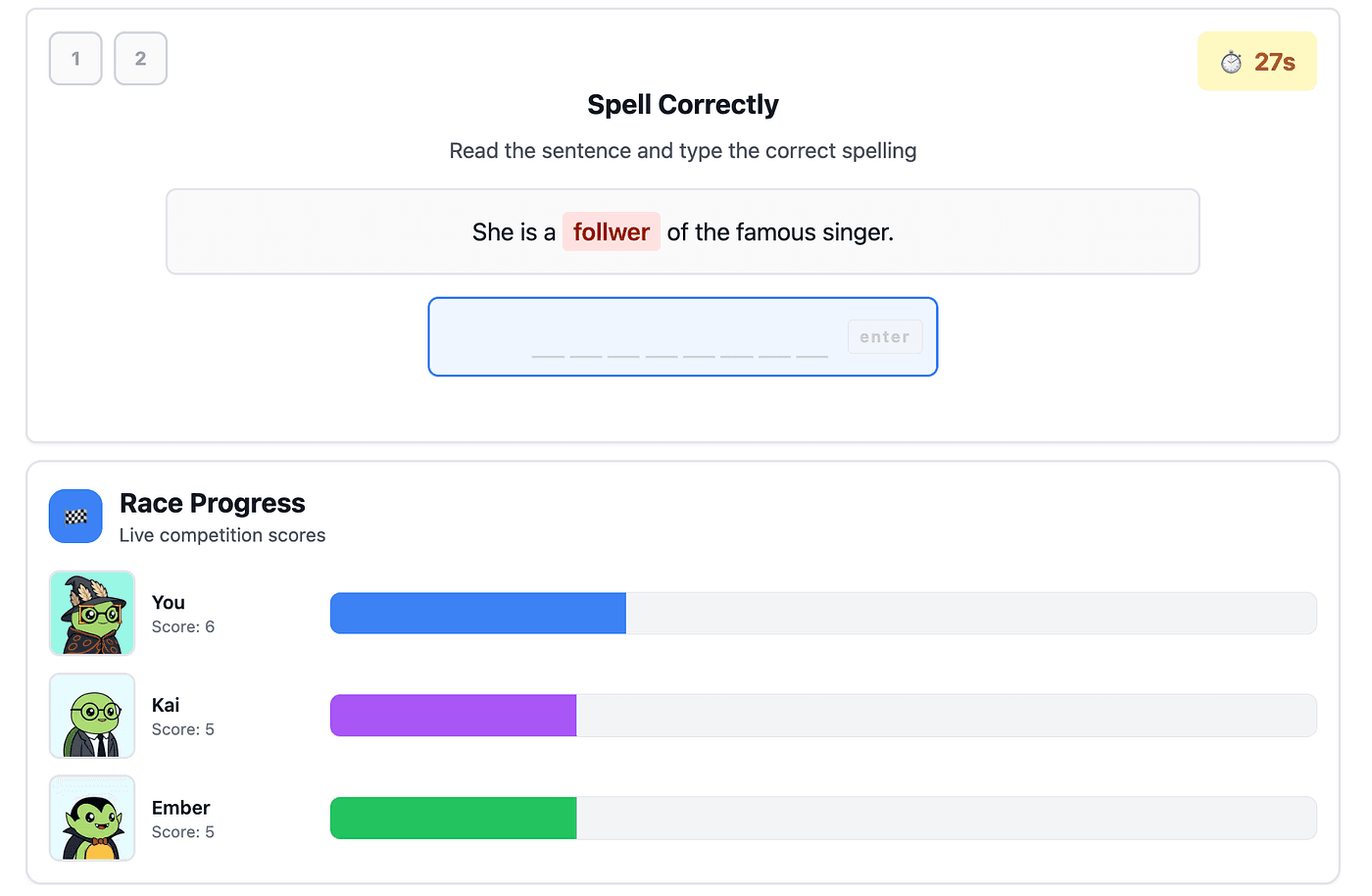
That’s why we’ve turned spelling and vocabulary practice into a fast-paced game — it’s quick, fun, and rewarding, so every student enjoys it.
And if you’re not part of EdAccelerator, you can still do this yourself.
All you need is a good vocabulary book, like 1100 Words You Need to Know, and the habit of spending just one minute a day.
How about Reading?
Everyone knows that reading is one of the most powerful habits a child can develop.
Parents often tell me they want their child to read more, but they struggle to get them started. Or their child is already finding reading difficult, and it’s beginning to show up in their comprehension results at school.
The problem is that, at school, students are often given books that are too hard or simply too boring. No one enjoys this.
But everyone enjoys reading when the book is at the right level and about something they actually care about.
So the key is simple:
find books that are both at the right level and fun to read.
The first part — finding the right level — is easy.
Every book is given what’s called a Lexile score, which shows how difficult it is to read.
A Lexile of 100L is perfect for early readers (around Year 1–2).
Around 600L suits middle primary students (Years 3–4).
1200L and above is more suitable for advanced readers in high school.
The key is to understand your child’s current Lexile level and choose books that sit just above what they can comfortably read — enough to challenge them, but not so hard that it feels discouraging.
You can look up the Lexile score of any book for free at Lexile.com.
Next, choose books that your child will actually enjoy.
A few popular and well-matched series for students in Years 3–8 include:
Harry Potter by J.K. Rowling
Percy Jackson by Rick Riordan
The Chronicles of Narnia by C.S. Lewis
These series are fantastic because once a child enjoys the first book, they’re motivated to keep reading the next — building more and more momentum.
The key from here is tracking progress.
At EdAccelerator, our students complete a short reading comprehension task every week so we can monitor their growth and gradually increase the level of passages and books they read.
At school, the average child’s Lexile level increases by just 75–125 points per year.
But it’s surprisingly easy to double or even triple that — reaching 200–300 points or more — simply by reading books at the right level and spending a few minutes each week practising comprehension.
But how about Writing?
Parents often tell me that their child “hates writing” and that they don’t know how to help — or even where to start.
Writing homework often turns into frustration and battles at home.
And despite months of tutoring, their child’s writing still seems stuck at the same level.
Writing is one of the hardest areas to see visible improvement in — but it’s also the area where I’ve seen the biggest transformations.
In one of our high-stakes aptitude test programs, students often entered the program 6–12 months ahead of the curriculum in maths, but were only average or below average in writing.
To succeed, they had to improve their writing — and fast.
And one thing made all the difference: the speed of feedback loops.
Students who wrote once a week and received feedback improved much faster than those who wrote only every few weeks.
But the students who wrote two or three times a week, and carefully reviewed and applied their feedback, improved at an even faster rate.
It makes sense, right?
For any other skill — sport, music, maths — you try, get feedback, adjust, and try again.
Writing works the same way, and research confirms it: the shorter the feedback loop, the faster the improvement.
The fastest way to improve your child’s writing is simple: get them writing as often as possible, and make sure they get feedback each time.
If you read most of our EdAccelerator reviews, you’ll notice that many parents mention one thing again and again — writing improvement — and this is why: fast feedback loops.
In the EdAccelerator program, students write twice a week in class and receive detailed feedback, which they immediately apply to improve their next piece.
Outside of class, most students write at least one extra piece each week for feedback — though some go even further.
And this is something you can easily do at home, too — even if you’re not part of the program.
The key is to make writing frequent, short, and reflective — so every piece becomes a chance to learn and grow.
The Bottom Line
After working with over 1,000 students, one truth has become clear: every child can improve in English — and enjoy it — when they focus on the right habits.
For Language, it’s about consistency — just one minute a day building spelling and vocabulary.
For Reading, it’s about engagement — finding books that are enjoyable and at the right level.
For Writing, it’s about fast feedback loops — writing often and learning from each piece.
These simple, repeatable habits create extraordinary results over time. Because progress in English doesn’t come from talent or endless tutoring — it comes from small actions done well, done often, and done with purpose.
Over the past few years, I’ve tutored more than 1,000 students in English.
Many of them started out disliking English — some even said they hated it. They couldn’t bear to start writing or read a book on their own.
Others were high-achieving students already working ahead of the school curriculum, looking to push themselves 6–12 months further. But even they often didn’t enjoy English - or felt unsure about how to actually keep improving.
But after speaking with hundreds of parents, I’ve heard the same thing again and again:
“We’ve tried other English tutoring, but it didn’t work. My child didn’t enjoy it, they resisted it, it led to friction and tears at home, or it just didn’t make a difference. I looked at their writing after a few months, and it still looked the same.”
This is the problem that so many parents face today.
But after working with thousands of students, it became clear to me that there are three key drivers of progress in English, one for each core domain of the subject.
English can be broken down into three components:
Writing — the ability to express ideas clearly and creatively.
Reading — the ability to understand, interpret, and analyse texts.
Language — the foundation of vocabulary, grammar, and sentence structure that supports both reading and writing.
And for each of these, there’s one simple strategy that almost guarantees improvement — no matter where a student starts.
The simplest place to start is with Language.
Many students join EdAccelerator struggling with spelling. They make frequent mistakes that hold back their writing.
Later on, parents start to worry that their child’s vocabulary isn’t growing fast enough. They struggle to use precise and powerful words in their writing and speaking.
This is the easiest problem to solve because it takes only one thing — consistency.
Even just one minute a day spent learning new words or practising to spell tricky words adds up overtime.
Even just one minute a day spent learning new words or practising to spell tricky words adds up over time.
Within the EdAccelerator program, we encourage students to spend a minimum of 1 minute per day on Spelling and 1 minute per day on Vocabulary.
The outcome? The average student learns to spell 8 new words each week and understand the meaning of 9.
That might not sound like much, but over time that’s around 70 words per month, or more than 850 words per year.
When you consider that at school the average student learns only 100–200 words explicitly per year, that’s 4 to 8 times more.
And that’s with just one minute a day. We have students who take it further — learning 30, 40, or even 50 new words a week.
You might be thinking, “But my child won’t even want to do a minute!”
That’s why we’ve turned spelling and vocabulary practice into a fast-paced game — it’s quick, fun, and rewarding, so every student enjoys it.
And if you’re not part of EdAccelerator, you can still do this yourself.
All you need is a good vocabulary book, like 1100 Words You Need to Know, and the habit of spending just one minute a day.
How about Reading?
Everyone knows that reading is one of the most powerful habits a child can develop.
Parents often tell me they want their child to read more, but they struggle to get them started. Or their child is already finding reading difficult, and it’s beginning to show up in their comprehension results at school.
The problem is that, at school, students are often given books that are too hard or simply too boring. No one enjoys this.
But everyone enjoys reading when the book is at the right level and about something they actually care about.
So the key is simple:
find books that are both at the right level and fun to read.
The first part — finding the right level — is easy.
Every book is given what’s called a Lexile score, which shows how difficult it is to read.
A Lexile of 100L is perfect for early readers (around Year 1–2).
Around 600L suits middle primary students (Years 3–4).
1200L and above is more suitable for advanced readers in high school.
The key is to understand your child’s current Lexile level and choose books that sit just above what they can comfortably read — enough to challenge them, but not so hard that it feels discouraging.
You can look up the Lexile score of any book for free at Lexile.com.
Next, choose books that your child will actually enjoy.
A few popular and well-matched series for students in Years 3–8 include:
Harry Potter by J.K. Rowling
Percy Jackson by Rick Riordan
The Chronicles of Narnia by C.S. Lewis
These series are fantastic because once a child enjoys the first book, they’re motivated to keep reading the next — building more and more momentum.
The key from here is tracking progress.
At EdAccelerator, our students complete a short reading comprehension task every week so we can monitor their growth and gradually increase the level of passages and books they read.
At school, the average child’s Lexile level increases by just 75–125 points per year.
But it’s surprisingly easy to double or even triple that — reaching 200–300 points or more — simply by reading books at the right level and spending a few minutes each week practising comprehension.
But how about Writing?
Parents often tell me that their child “hates writing” and that they don’t know how to help — or even where to start.
Writing homework often turns into frustration and battles at home.
And despite months of tutoring, their child’s writing still seems stuck at the same level.
Writing is one of the hardest areas to see visible improvement in — but it’s also the area where I’ve seen the biggest transformations.
In one of our high-stakes aptitude test programs, students often entered the program 6–12 months ahead of the curriculum in maths, but were only average or below average in writing.
To succeed, they had to improve their writing — and fast.
And one thing made all the difference: the speed of feedback loops.
Students who wrote once a week and received feedback improved much faster than those who wrote only every few weeks.
But the students who wrote two or three times a week, and carefully reviewed and applied their feedback, improved at an even faster rate.
It makes sense, right?
For any other skill — sport, music, maths — you try, get feedback, adjust, and try again.
Writing works the same way, and research confirms it: the shorter the feedback loop, the faster the improvement.
The fastest way to improve your child’s writing is simple: get them writing as often as possible, and make sure they get feedback each time.
If you read most of our EdAccelerator reviews, you’ll notice that many parents mention one thing again and again — writing improvement — and this is why: fast feedback loops.
In the EdAccelerator program, students write twice a week in class and receive detailed feedback, which they immediately apply to improve their next piece.
Outside of class, most students write at least one extra piece each week for feedback — though some go even further.
And this is something you can easily do at home, too — even if you’re not part of the program.
The key is to make writing frequent, short, and reflective — so every piece becomes a chance to learn and grow.
The Bottom Line
After working with over 1,000 students, one truth has become clear: every child can improve in English — and enjoy it — when they focus on the right habits.
For Language, it’s about consistency — just one minute a day building spelling and vocabulary.
For Reading, it’s about engagement — finding books that are enjoyable and at the right level.
For Writing, it’s about fast feedback loops — writing often and learning from each piece.
These simple, repeatable habits create extraordinary results over time. Because progress in English doesn’t come from talent or endless tutoring — it comes from small actions done well, done often, and done with purpose.
Over the past few years, I’ve tutored more than 1,000 students in English.
Many of them started out disliking English — some even said they hated it. They couldn’t bear to start writing or read a book on their own.
Others were high-achieving students already working ahead of the school curriculum, looking to push themselves 6–12 months further. But even they often didn’t enjoy English - or felt unsure about how to actually keep improving.
But after speaking with hundreds of parents, I’ve heard the same thing again and again:
“We’ve tried other English tutoring, but it didn’t work. My child didn’t enjoy it, they resisted it, it led to friction and tears at home, or it just didn’t make a difference. I looked at their writing after a few months, and it still looked the same.”
This is the problem that so many parents face today.
But after working with thousands of students, it became clear to me that there are three key drivers of progress in English, one for each core domain of the subject.
English can be broken down into three components:
Writing — the ability to express ideas clearly and creatively.
Reading — the ability to understand, interpret, and analyse texts.
Language — the foundation of vocabulary, grammar, and sentence structure that supports both reading and writing.
And for each of these, there’s one simple strategy that almost guarantees improvement — no matter where a student starts.
The simplest place to start is with Language.
Many students join EdAccelerator struggling with spelling. They make frequent mistakes that hold back their writing.
Later on, parents start to worry that their child’s vocabulary isn’t growing fast enough. They struggle to use precise and powerful words in their writing and speaking.
This is the easiest problem to solve because it takes only one thing — consistency.
Even just one minute a day spent learning new words or practising to spell tricky words adds up overtime.
Even just one minute a day spent learning new words or practising to spell tricky words adds up over time.
Within the EdAccelerator program, we encourage students to spend a minimum of 1 minute per day on Spelling and 1 minute per day on Vocabulary.
The outcome? The average student learns to spell 8 new words each week and understand the meaning of 9.
That might not sound like much, but over time that’s around 70 words per month, or more than 850 words per year.
When you consider that at school the average student learns only 100–200 words explicitly per year, that’s 4 to 8 times more.
And that’s with just one minute a day. We have students who take it further — learning 30, 40, or even 50 new words a week.
You might be thinking, “But my child won’t even want to do a minute!”
That’s why we’ve turned spelling and vocabulary practice into a fast-paced game — it’s quick, fun, and rewarding, so every student enjoys it.
And if you’re not part of EdAccelerator, you can still do this yourself.
All you need is a good vocabulary book, like 1100 Words You Need to Know, and the habit of spending just one minute a day.
How about Reading?
Everyone knows that reading is one of the most powerful habits a child can develop.
Parents often tell me they want their child to read more, but they struggle to get them started. Or their child is already finding reading difficult, and it’s beginning to show up in their comprehension results at school.
The problem is that, at school, students are often given books that are too hard or simply too boring. No one enjoys this.
But everyone enjoys reading when the book is at the right level and about something they actually care about.
So the key is simple:
find books that are both at the right level and fun to read.
The first part — finding the right level — is easy.
Every book is given what’s called a Lexile score, which shows how difficult it is to read.
A Lexile of 100L is perfect for early readers (around Year 1–2).
Around 600L suits middle primary students (Years 3–4).
1200L and above is more suitable for advanced readers in high school.
The key is to understand your child’s current Lexile level and choose books that sit just above what they can comfortably read — enough to challenge them, but not so hard that it feels discouraging.
You can look up the Lexile score of any book for free at Lexile.com.
Next, choose books that your child will actually enjoy.
A few popular and well-matched series for students in Years 3–8 include:
Harry Potter by J.K. Rowling
Percy Jackson by Rick Riordan
The Chronicles of Narnia by C.S. Lewis
These series are fantastic because once a child enjoys the first book, they’re motivated to keep reading the next — building more and more momentum.
The key from here is tracking progress.
At EdAccelerator, our students complete a short reading comprehension task every week so we can monitor their growth and gradually increase the level of passages and books they read.
At school, the average child’s Lexile level increases by just 75–125 points per year.
But it’s surprisingly easy to double or even triple that — reaching 200–300 points or more — simply by reading books at the right level and spending a few minutes each week practising comprehension.
But how about Writing?
Parents often tell me that their child “hates writing” and that they don’t know how to help — or even where to start.
Writing homework often turns into frustration and battles at home.
And despite months of tutoring, their child’s writing still seems stuck at the same level.
Writing is one of the hardest areas to see visible improvement in — but it’s also the area where I’ve seen the biggest transformations.
In one of our high-stakes aptitude test programs, students often entered the program 6–12 months ahead of the curriculum in maths, but were only average or below average in writing.
To succeed, they had to improve their writing — and fast.
And one thing made all the difference: the speed of feedback loops.
Students who wrote once a week and received feedback improved much faster than those who wrote only every few weeks.
But the students who wrote two or three times a week, and carefully reviewed and applied their feedback, improved at an even faster rate.
It makes sense, right?
For any other skill — sport, music, maths — you try, get feedback, adjust, and try again.
Writing works the same way, and research confirms it: the shorter the feedback loop, the faster the improvement.
The fastest way to improve your child’s writing is simple: get them writing as often as possible, and make sure they get feedback each time.
If you read most of our EdAccelerator reviews, you’ll notice that many parents mention one thing again and again — writing improvement — and this is why: fast feedback loops.
In the EdAccelerator program, students write twice a week in class and receive detailed feedback, which they immediately apply to improve their next piece.
Outside of class, most students write at least one extra piece each week for feedback — though some go even further.
And this is something you can easily do at home, too — even if you’re not part of the program.
The key is to make writing frequent, short, and reflective — so every piece becomes a chance to learn and grow.
The Bottom Line
After working with over 1,000 students, one truth has become clear: every child can improve in English — and enjoy it — when they focus on the right habits.
For Language, it’s about consistency — just one minute a day building spelling and vocabulary.
For Reading, it’s about engagement — finding books that are enjoyable and at the right level.
For Writing, it’s about fast feedback loops — writing often and learning from each piece.
These simple, repeatable habits create extraordinary results over time. Because progress in English doesn’t come from talent or endless tutoring — it comes from small actions done well, done often, and done with purpose.